Numeric Dogma
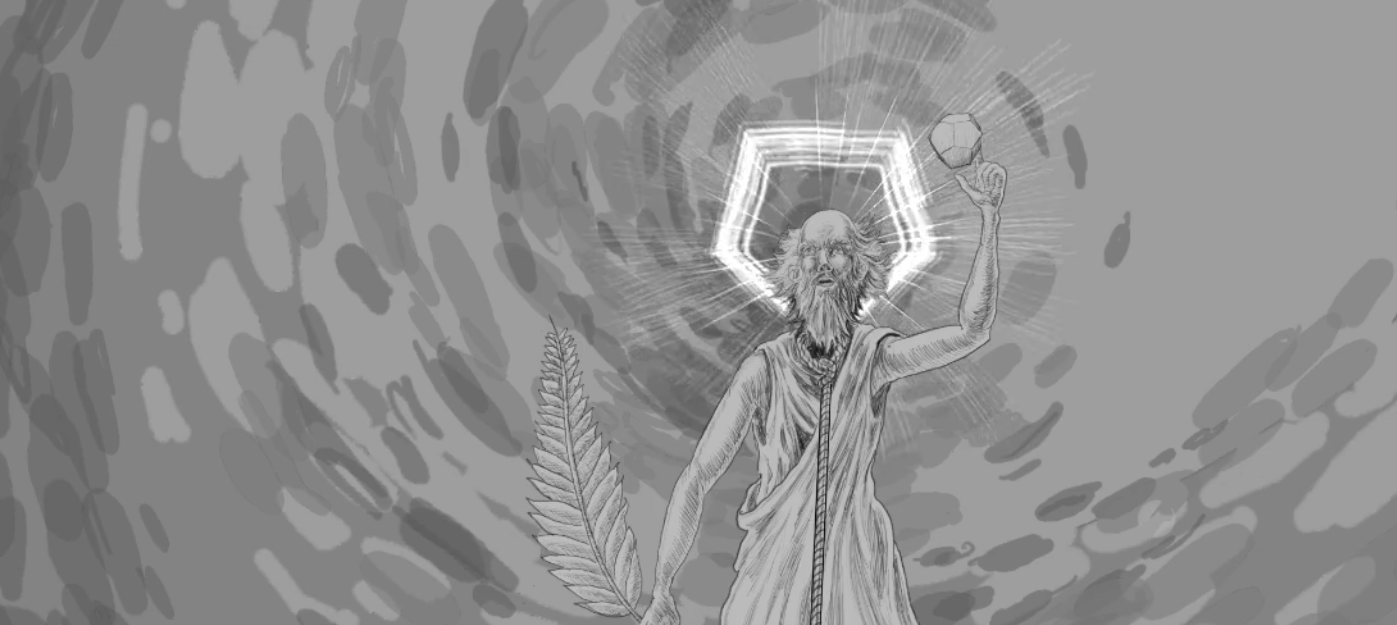
This is a continuation of a Christian iconography study I have been building. This time I wanted to draw a different kind of saint, a new class of saint even: a scientific one. The subject is Hippasus of Metapontum, and his story is strange enough that by the end you may agree he earned the halo. To get to him, though, we have to begin somewhere you would not expect, with a pattern you already know.
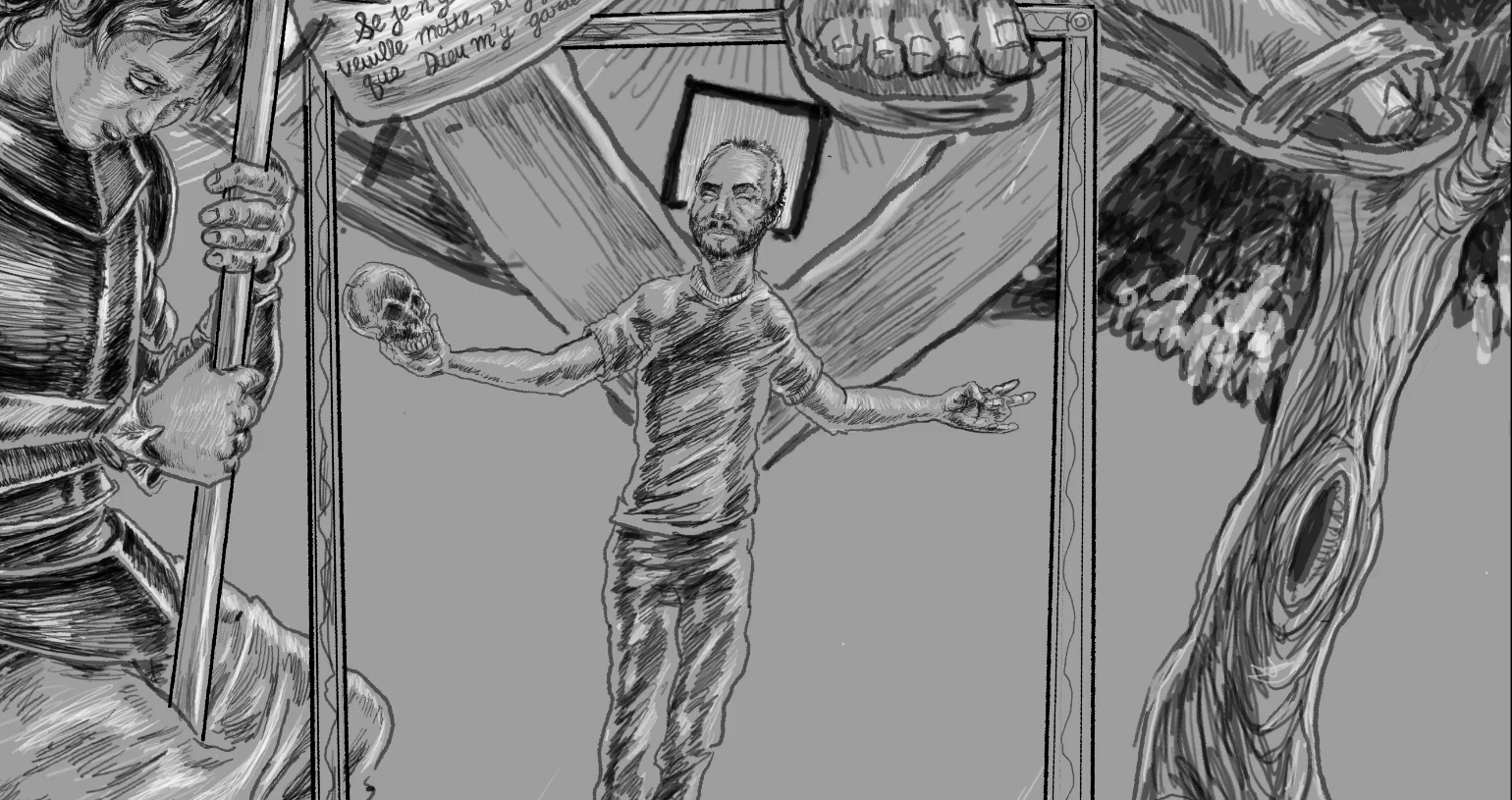
As an artist, you should be familiar with the Golden Ratio. It is a pattern that is seen all over nature, most famously in the spiral packing of sunflower seeds. It's a known pattern that can make compositions more pleasing to the eye. The concept of it brings up an interesting dichotomy between the artist's way of thinking, the right side of the brain, and the logical left side of the brain. Call it a metaphor, the literal neuroscience is messier than the folk version. Conceptually it is a pattern, it exists and its existence is intuitive in the sense that we've seen it everywhere since we were born in this place.
As humans we've developed two modes of communication, each more suited to a particular side of the brain. Text-based language: we use this system in many cases to try to describe our experiences to another person. Text as a medium is not capable of describing anything with perfect accuracy. We largely don't use it for this purpose. Instead we invoke properties of a particular thing by sameness or difference for comparison. Or we try to invoke emotions or other particular feelings by sharing metaphorical descriptions that fit: "A pit in your stomach," "walking on a cloud." Words that evoke imagery, while evoking the feeling... Never quite able to capture the thing. It could be said we accept the ambiguity of text; it operates as a feature for the system. Text-based language could be said to have positive or creating polarity.
Mathematics, our second language, is concerned with quite the opposite. It is the language we use to capture the material things in the world. We can count all of our fingers and toes, and we know they belong to us. Likewise, the same applies to any physical piece of property we possess. This in some sense provides us with a certain amount of security. We can find solace in knowing exactly how many beans we have, and can measure when we need more, so we won't starve. Side note, it's said that a key Pythagorean taboo was the bean. Perhaps rooted in the deep-seeded aversion to being called a bean counter... Here is the piece as it comes together, the figure reaching up with a strange many-sided solid, a shape you cannot arrive at by counting.
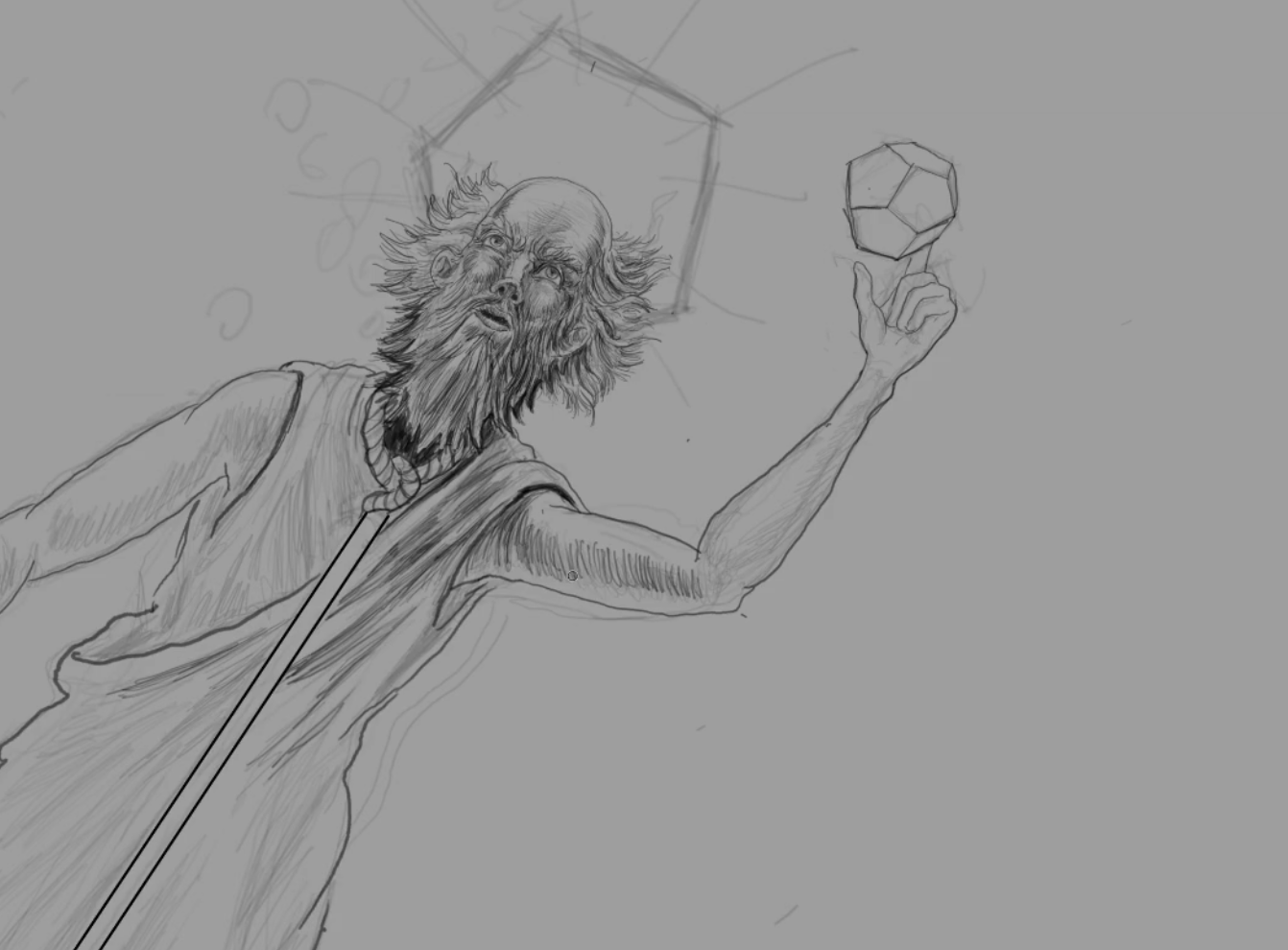
In this way we strive to make mathematics as precise as possible, believing it will provide a deeper understanding of the world. Its feature is its accuracy in describing the things in the world. Mathematics could be said to have a negative or reductive polarity.
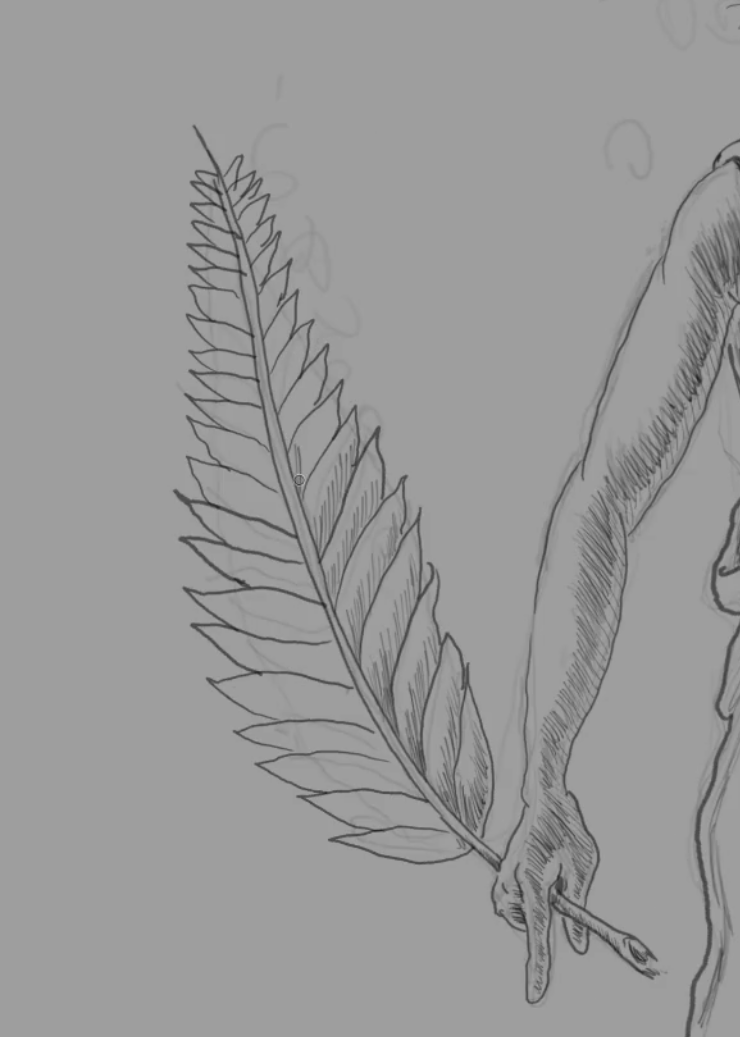
This brings me to Hippasus of Metapontum, a Greek philosopher and early follower of Pythagoras. As with any saint, I begin with the attributes. Into his hand I place the martyr's palm, the frond the tradition gives for victory over sin and death.
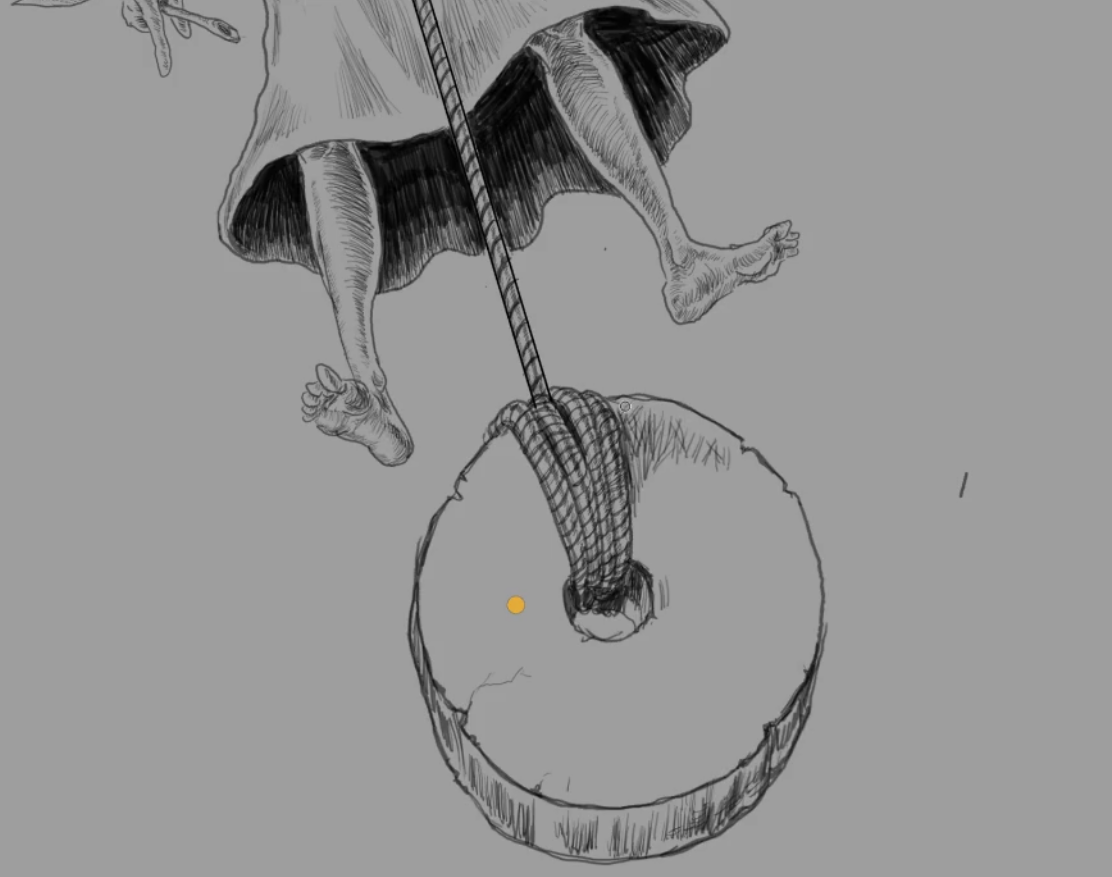
The most popular version of his story states that he 'discovered' irrational numbers. It is told that the Pythagoreans had developed a numerical framework they believed described the world in mathematics completely. As you can imagine, with such claims you will garner many followers who believe you help them unlock the secrets of the universe. That the entire world could be measured in terms of rational numbers. In essence that the cosmos could be described in perfect squares or perfect cubes. It's said that Hippasus attempted to find the ratio of a square's diagonal to its side. This produced an irrational result. It's said the cult members couldn't accept the truth uncovered, and drowned him for his revolutionary discovery. For the manner of his death I gave him a millstone, the attribute of saints who were drowned, a stone hung at the neck and the body cast into the water. It doubles as a wheel, which feels apt for a man undone by a number that would not come out clean.
A story that illustrates the ignorance of religion when faced with contrary scientific evidence.
The trouble with this story is... there is no way it could be true. This is what my intuition told me when I first heard it. I thought: "You mean to tell me, they calculated that the entire natural world could be measured in terms of the square... Yet they never took the time to calculate the ratio of that same sacred square's diagonal?" It seems false simply on its face, a key primitive in the system would have to have been tested thoroughly. Scholars have made the same argument. The classic reconstruction says the discovery likely came not through the square at all, but through the pentagram, the cult's own sacred emblem, whose diagonals hide the golden ratio. The number we started with was sitting inside their badge the whole time. So that is the halo I gave him. Not the round disc of an ordinary saint but a pentagon, the cult's own five-pointed star, the very shape that was hiding the number all along.
As it turns out, there are in fact two versions of this story.
The alternative version of this story is that the Pythagoreans were basically a Mystery Cult. A key aspect of a Mystery Cult is that it has Mysteries. Most tellings say Hippasus exposed a coveted secret: how to construct the dodecahedron. For clarification, a dodecahedron requires irrational numbers in order to construct it. So it disproves the cosmos can be defined by perfect squares or perfect cubes. Perhaps Hippasus was showing off without realizing the cult already knew the golden ratio, a coveted secret. Perhaps it was some sort of attempted power move within the cult. Either way it's said he was drowned for divulging the secret of the irrational number, not discovering irrational numbers.
The popular notion that Hippasus discovered irrational numbers creates an unwarranted form of bias toward mathematics and science. It does this in a way that seems to appeal to those who would view science and mathematics as the ultimate good in the world. Let's take the theory and presume that it is true. That Hippasus did upturn the cult member dogma through more rigorous inspection of one of their key primitives. Conceptually, is it really true to say that he 'discovered' irrational numbers? When the first person created the numbers 1 through 10 to quantify their digits, did they 'discover' the numbers 1 through 10? I'd lean toward the answer being no.
Artists likely knew long before Pythagoras that arranging elements in a visual composition causes the eye to move. This is a pattern that is already in nature, so even the artist is either picking up on it without knowing it or using it with full knowledge. With the language of math, we can describe this motion as a never-ending number. Even so, seeing the number never end with every new calculation and observing that your eye never settles when the golden ratio is used in composition is effectively the same. Neither can fully capture what is going on. For the artist, the ratio adds to the expression. While mathematics seems to be concerned with capturing it. It's a fitting detail that mathematics itself ranks the golden ratio as the most irrational number of all, the one whose digits resist settling harder than any other number's. The number that refuses hardest to be captured is the very one artists reach for when they want the eye to never rest. Both polarities complete the circuit of creation and perception. Dogma comes from thinking any language can provide the answers to the cosmos, artistically or mathematically.